


.png)
The Inflation Reduction Act is already affecting 340B program revenue, and the impact is going to grow. For covered entities with in-house pharmacies, the effects are immediate and complex. For those relying on contract pharmacies, the revenue pressure is real but often less visible. Either way, understanding what is happening now matters, because 2027 will be significantly more difficult than 2026.
This piece explains how the IRA is affecting covered entities today, where the MFP rebate process is breaking down, and what practical steps your team can take.
The IRA authorized Medicare to negotiate prices directly with drug manufacturers on a select group of drugs, resulting in a Maximum Fair Price for each selected drug. Medicare began reimbursing at MFP rates for the first ten negotiated drugs in 2026.
For covered entities, this creates a margin compression problem. The 340B program saves money by allowing covered entities to purchase drugs at a discount relative to what they charge payers. When Medicare reimbursement drops to MFP, the gap between the 340B purchase price and the reimbursement rate shrinks. On some drugs, that margin has effectively disappeared.
This affects covered entities differently depending on how they dispense:
In-house pharmacies are seeing smaller margins on IRA drugs and are also experiencing a separate, compounding problem: MFP rebates on non-340B claims are not being paid correctly. When a drug is purchased on a non-340B account, the entity is reimbursed at MFP and is supposed to receive a rebate that makes up the difference from what was paid. Reports indicate that approximately 40% of MFP rebates that should have been approved are not being paid. The result is that covered entities are losing money on non-340B purchases of these drugs while waiting for rebates that may or may not arrive.
.png)
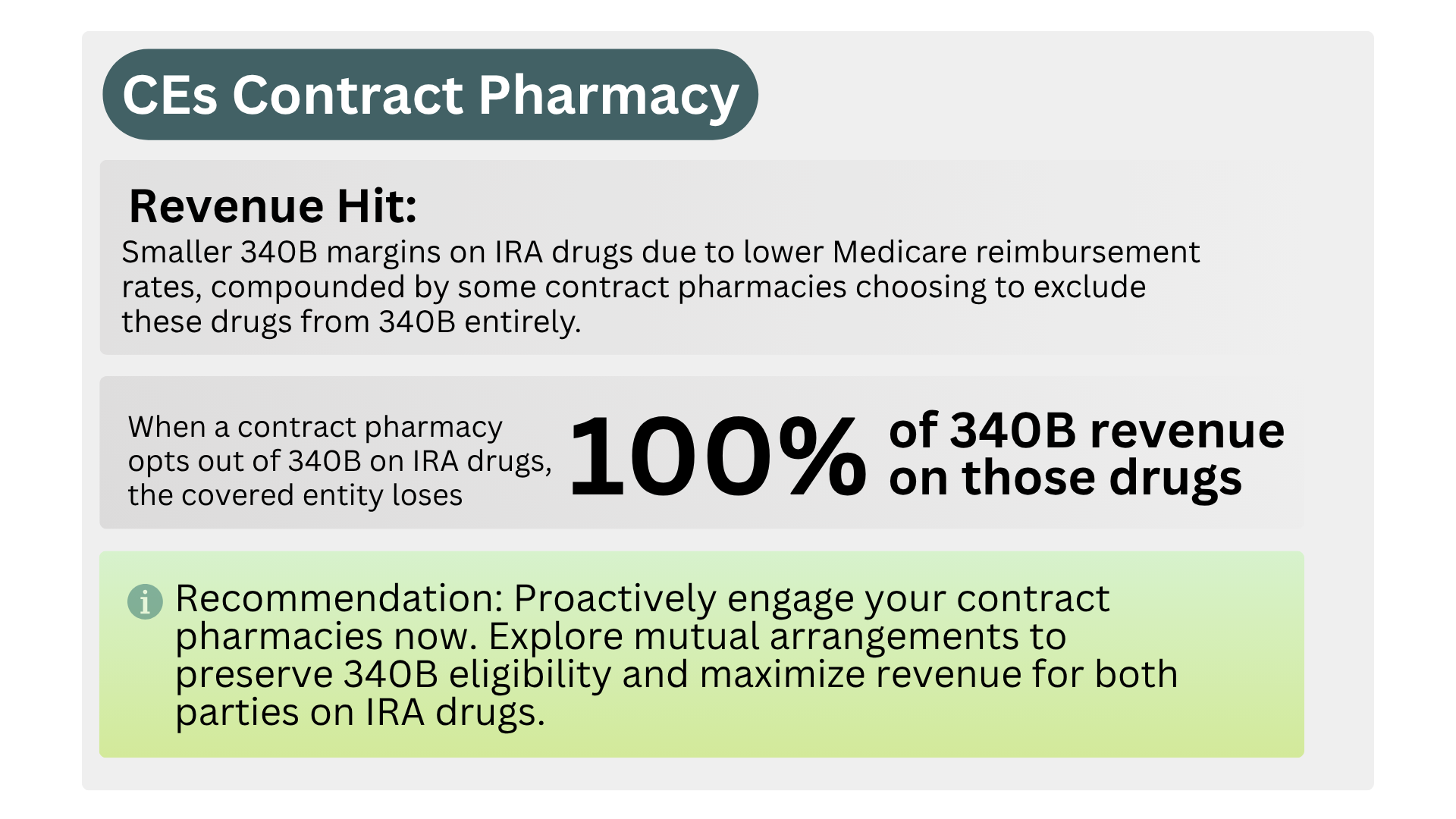
Contract pharmacy settings face the same margin compression, with an additional risk. Some contract pharmacies are choosing to exclude IRA drugs from 340B entirely, or to exclude them specifically when a Medicare payer is present. When a contract pharmacy excludes these drugs, the covered entity loses all 340B revenue associated with those dispenses. This is a decision being made by the pharmacy, often without input from the covered entity, and covered entities typically do not have direct access to the Beacon MFP platform to monitor what is happening with those claims.
There are also reports that some pharmacies that have never participated in 340B are having their MFP rebates denied on the basis of being classified as 340B claims. The system is not functioning cleanly, and the problems are concentrated but not limited to any one pharmacy type.
For covered entities with in-house pharmacies, managing MFP rebates is now an ongoing operational obligation. Here is how the process is supposed to work.
.png)
Step one is enrollment. Register your entity with Beacon MFP if you have not already. The platform is not technically required, but it is the primary mechanism for tracking rebate status and initiating disputes. Contract pharmacies manage their own Beacon enrollment, but you may be able to request access to assist with 340B claim identification.
Step two is identifying your 340B claims. Within Beacon MFP, you can mark individual claims as 340B, or mark an entire pharmacy as 340B-only if it is a closed-door pharmacy that exclusively serves 340B patients. You can also apply Submission Clarification Code 20 to pharmacy claims at the point of billing to signal that the claim involves a 340B drug. As of January 1, 2025, SCC 20 and Submission Type Code AA are added to the Prescription Drug Event record to indicate a 340B claim.
Step three is submitting clean ESP data. Beacon MFP and manufacturers rely on ESP dispense data to verify which claims are 340B. Accurate, complete ESP submissions are a prerequisite for the MFP rebate process to work as intended.
When a claim is incorrectly flagged: If Beacon MFP identifies a claim as 340B when it was not, you can open a good faith inquiry through the Beacon MFP Resolution Center. Search for the claim by its Internal Control Number, create a new inquiry, indicate the claim was not a 340B claim, and upload the relevant 340B claims data that correspond to the wholesaler invoice number Beacon references. ESP and Beacon MFP are separate platforms that work together in this process, and navigating both adds to the administrative load.
In practice, this process is not running smoothly. Reconciliation is time-intensive, denials are inconsistent, appeals processes are unclear, and the infrastructure requires ongoing attention. The webinar poll on rebate payment rates found a significant share of attendees were missing substantial portions of what they were owed.
The financial picture gets more difficult next year. Among the drugs selected under the IRA for the 2026 payment year, approximately 80% have been assessed as profitable for 340B programs after accounting for the MFP rate. For 2027 selected drugs, that figure drops to approximately 35%.
.png)
High-utilization drugs on the 2027 list that fall into the non-profitable category include Ozempic, Rybelsus, Wegovy, Breo Ellipta, Trelegy Ellipta, Vraylar, Austedo, Ofev, Ibrance, Calquence, and Pomalyst. If your program dispenses any of these at meaningful volume, 2027 will require planning that has not been necessary before.
Beyond 2027, the IRA's negotiation authority expands to Medicare Part B drugs beginning in 2028. For many covered entities, Part B represents a significant portion of 340B activity. Adding Part B drugs to the negotiated list will extend the margin compression problem beyond pharmacy and into the medical benefit side of the program.
.png)
If your entity has an in-house pharmacy, enroll in Beacon MFP and start tracking your rebate payments against what should have been approved. Do not wait for problems to accumulate before establishing a reconciliation process.
Analyze your 2027 drug exposure now. Pull your dispense data for the drugs on the 2027 selected list and assess the financial impact of moving from the current 340B margin to a compressed or negative margin on those drugs.
Talk to your contract pharmacies. If your pharmacy partners are excluding IRA drugs from 340B, have a direct conversation about whether there is a mutual arrangement that preserves 340B eligibility and revenue for both parties.
Assign ownership for ongoing rebate reconciliation. Submitting claims is not the end of the process. Someone in your organization needs to own monitoring payment status, identifying denials, and initiating disputes when rebates are missed. That role needs to be defined before it becomes urgent.
RxTrail runs IRA impact analyses for covered entities, including projections for both 2026 and 2027 drug lists based on your actual utilization data. We work through the financial exposure, identify reconciliation gaps, and help build the operational workflows needed to manage this over time. If you want to understand your specific exposure, reach out.

