


.png)
HRSA published its list of approved manufacturers for the revised 340B Rebate Model Pilot Program on October 1, 2026. Ten manufacturers now have approved plans covering roughly 18 to 21 drugs, depending on how extended-release variants are counted, set to take effect January 1, 2027. If your program touches any of these drugs, the way you get paid for them is about to change.
Under the current 340B model, a covered entity buys a drug at the discounted 340B price up front. Under the rebate model, that flips. The covered entity buys the drug at wholesale acquisition cost, the full price, and then submits a claim to the manufacturer for a rebate equal to the difference between WAC and the 340B ceiling price. The discount arrives after the purchase, not at the point of sale.
HRSA's approved structure requires claims-level identification of each transaction, submitted by the covered entity within 45 calendar days of dispensing. Manufacturers then have 10 calendar days to pay the rebate or deny it with documentation. All approved manufacturers are using the same platform, Second Sight Solutions' Beacon Rebate Model Platform, to administer this.
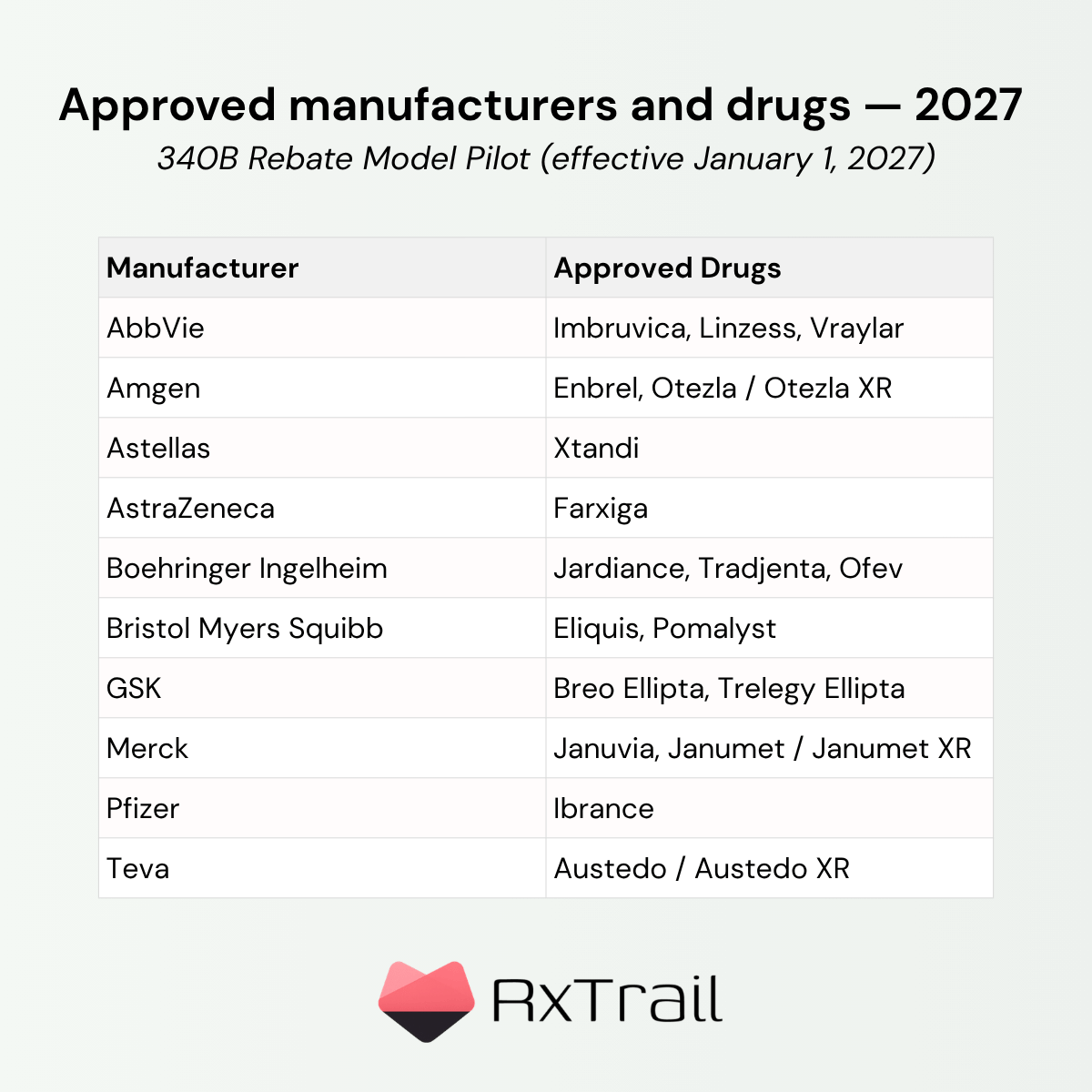
HRSA approved plans from AbbVie (Imbruvica, Linzess, Vraylar), Amgen (Enbrel, Otezla/Otezla XR), Astellas (Xtandi), AstraZeneca (Farxiga), Boehringer Ingelheim (Jardiance, Tradjenta, Ofev), Bristol Myers Squibb (Eliquis, Pomalyst), GSK (Breo Ellipta, Trelegy Ellipta), Merck (Januvia, Janumet/Janumet XR), Pfizer (Ibrance), and Teva (Austedo/Austedo XR).
Notably absent: AstraZeneca's Calquence and Novo Nordisk's Ozempic, Rybelsus, and Wegovy were eligible for the pilot but are not among the approved plans. It is not publicly known whether those manufacturers chose not to apply or applied and were not approved. Also absent, but for a different reason, are four drugs that had Medicare maximum fair prices in 2026 but lost that status for 2027, making them ineligible regardless of manufacturer intent: Johnson & Johnson's Stelara and Xarelto, Novartis's Entresto, and Novo Nordisk's Novolog/Fiasp.
This is not HRSA's first attempt at a rebate model. HRSA approved eight manufacturer plans for an earlier pilot in October 2025, with a ninth added later, set to take effect at the start of 2026. Hospital groups sued in federal court that December, and the court granted a preliminary injunction on December 29, 2025, pausing the pilot before it took effect. HHS appealed, the First Circuit declined to lift the pause, and HHS then withdrew its own appeal in January 2026. The district court formally vacated the original pilot notice and the manufacturer approvals in February 2026, which is why HRSA had to restart the process with this revised version.
A separate, related ruling gives the revised pilot some additional legal footing. In July 2026, a federal appeals court held that manufacturers cannot roll out a rebate model on their own, without HRSA approval first. Combined with changes HRSA made to this version of the pilot, that is the basis for attorneys describing it as built on stronger ground than the first attempt. Another legal challenge from providers is still considered likely, though none had been filed as of this writing.
Opposition to the rebate model is active in both the advocacy and legislative arenas right now. The American Hospital Association has disputed HRSA's cost estimate for the program, arguing the agency's figure of roughly $523 million understates the real administrative and cash-flow burden, with AHA's own estimate exceeding $1 billion. America's Essential Hospitals has said HRSA's response to provider concerns does not adequately address the cash-flow disruption smaller programs are likely to face.
HRSA's own published response to these cost concerns points to independent cash-flow modeling, including studies from IQVIA and 3 Axis Advisors, that found the shift to rebates has limited impact on covered entities' interest costs and liquidity, particularly for contract pharmacy purchases. That is part of why HRSA has not revised its administrative cost estimate in response to AHA's and AEH's objections.
Separately, more than 50 national, state, and regional community health center associations, led by the National Association of Community Health Centers, sent a letter to U.S. House Energy and Commerce Committee leadership on September 30 asking for a hearing on the pilot's implementation. A separate, bipartisan group of House members has also circulated a letter seeking language in the FY27 appropriations bill that would block funding for the rebate model's implementation.
None of this has changed the January 1, 2027 effective date so far.
Check whether any drug your program dispenses or administers is on the approved list. If none of your volume touches these 10 manufacturers' approved drugs, this does not change your cash flow on January 1. If it does, the WAC-to-rebate gap is a real, temporary cash-flow cost your program needs to plan for.
Confirm your 45-day claims submission capability. The rebate model only pays out if claims-level data is submitted accurately and on time. This is a new operational requirement layered onto existing data reporting work, not a replacement for it.
Track the legislative and legal activity, but don't plan around it. A House hearing request and an appropriations rider effort are both live, and a legal challenge is considered likely by attorneys watching this closely. None of that has stopped the program from moving forward so far, and planning as though it will be blocked is a riskier bet than preparing for January 1 as scheduled.
We help covered entities identify which of their purchased drugs fall under an approved rebate plan, build the claims submission process the model requires, and model the cash-flow impact of moving from up-front discounts to after-the-fact rebates on the specific drugs affected. Our job is making sure the operational and financial pieces are ready before January 1. The entity's job is deciding how to manage the cash-flow gap internally once we've sized it.
Does this apply to our whole 340B program? No. It applies only to the specific drugs covered by an approved manufacturer plan. Most of your 340B purchasing is unaffected unless you have meaningful volume in the drugs listed above.
Is this definitely happening on January 1, 2027? That is the current effective date and HRSA has not announced any delay. Given that an earlier version of this program was blocked by litigation, and a new challenge is considered likely, the timeline carries real uncertainty. Plan for January 1 while watching for legal developments.
What happens to our cash flow under the rebate model? You pay WAC up front instead of the discounted 340B price, then wait for a rebate that manufacturers must pay or deny within 10 days of a properly submitted claim. The size of that gap depends entirely on your volume in the affected drugs and how quickly you can submit accurate claims.
Why weren't Ozempic, Wegovy, and Calquence included? That has not been publicly explained. They were eligible based on their Medicare maximum fair price status, but are not part of any approved manufacturer plan in this round.
Could this program still get blocked like the first one? It's possible. Attorneys following this closely have said the revised pilot appears to be built on stronger legal footing than the version that was blocked, but a new challenge from providers is considered likely.

